11.8. Application Messaging and Configuration
GEISA LwM2M Object /3600 provides an app-scoped messaging path for a
specific application or application instance. Distinct resources are defined
for Server to Client messaging and Client to Server messaging. Each Object
Instance represents the ADM messaging path for one managed application
instance or application messaging scope identified by resource 4050 AppID.
Object /3600 is intended for application-facing message payload exchange,
configuration delivery, and transport metadata. It can carry app-domain
configuration, commands, command results, status, events, alarms, application
data, telemetry, and other application-specific payloads as classified by the
Message Type resource. It is not a durable event, message, or log history
store.
Server to Client messages are written to resource 0 Server Message. They
typically carry app-facing configuration, commands, or other application
payloads from an upstream consumer application, EMS, or operator workflow to
the edge application. An ADM-conformant platform receiving a Server Message
SHALL route the message payload and associated message metadata to the
application or application instance identified by resource 4050 AppID
through the corresponding GEISA downstream application-facing message API,
subject to authorization, routing policy, application lifecycle state, and
platform policy.
Client to Server messages are exposed through resource 1 Client Message
and are typically consumed by upstream applications, EMS workflows, or other
authorized endpoints. They typically carry command results, status, events,
alarms, application data, telemetry, or effective configuration state from
the edge application toward an upstream consumer application, EMS, or
operator workflow. An ADM-conformant EMS MAY read or observe this resource
according to the advertised object model, operator policy, authorization, and
deployment network constraints.
Message Priority values are:
0– Unspecified1– Urgent: highest priority; send immediately when possible2– Immediate: high priority; send as soon as possible3– BestEffort: normal priority; send when resources are available4– Latest: lowest priority; retain/send only the latest applicable message. When a “Latest” message is received, older messages of the same type for the same AppID may be superseded/dropped.5through100– Reserved for future GEISA use101through254– Reserved for proprietary use255– Reserved
Message Type values are:
0–UNSPECIFIED: message type is not specified or not yet classified1–CONFIG: app-facing desired or effective configuration state2–COMMAND: action request to perform work now or soon3–COMMAND_RESULT: result of aCOMMANDexecution, distinct from transport-level response acceptance4–STATUS: current state, lifecycle, readiness, mode, or policy/quota state5–EVENT: operationally meaningful occurrence worth recording or routing6–ALARM: actionable, high-severity, security, safety, or policy condition requiring prompt attention or special handling7–APP_DATA: supplemental application-specific data that intentionally does not fitCONFIG,COMMAND,STATUS,EVENT,ALARM,COMMAND_RESULT, orTELEMETRY8–TELEMETRY: measurement-oriented numeric or structured observations, usually time-series, snapshot, interval, or resource metrics9through100– Reserved for future GEISA use101through254– Reserved for proprietary use255– Reserved
Each app message is associated with Message Priority, Message Type, Message
TTL, and Content Type metadata. The platform and EMS use this metadata to
classify, schedule, route, retain, expire, and interpret app-message payloads
exchanged through resource 0 or resource 1. Resource 4 Message TTL
does not define event-log retention, and resource 5 Content Type does not
expose payload history.
Application configuration carried through Object /3600 is edge application
configuration. It is configuration payload exchanged between an upstream
consumer application, EMS, or operator workflow and the edge application
identified by resource 4050 AppID. A Server to Client message with Message
Type CONFIG may carry desired application configuration, or request current
configuration. A Client to Server message with Message Type CONFIG or
STATUS may carry application-reported effective configuration,
configuration status, or configuration-related state.
Object /3600 does not define the internal schema of an application
configuration payload. The payload format is identified by Content Type and is
interpreted according to the application, operator, or deployment contract.
Acceptance of a Server Message by the ADM path does not by itself prove that
the application accepted or applied the configuration. Application-level
acceptance, rejection, effective state, or error detail should be reported
through an appropriate app message, status, event, alarm, or durable record.
Application configuration through Object /3600 does not replace the
application manifest, Software Management Object /9, Application
Accounting Object /3602, Application Monitoring Object /3604, or GEISA
Platform Effective Configuration Object /3606. Manifest and deployment policy define
what an application is allowed to do; Object /3600 carries app-facing
configuration payloads within those permissions and platform policies.
Resource ID |
Name |
Operation |
Data Type |
Description |
|---|---|---|---|---|
4050 |
AppID |
ReadWrite |
Unsigned Integer |
System-unique identifier for the logical application within the applicable management domain. |
4051 |
Software Instance |
Read |
Objlnk |
Link to the corresponding LwM2M Software Management |
0 |
Server Message |
Write |
Opaque |
Server to Client app-message payload. |
1 |
Client Message |
Read |
Opaque |
Client to Server app-message payload. |
2 |
Message Priority |
ReadWrite |
Unsigned Integer |
Per-message priority for ordering, scheduling, throttling, or delivery. |
3 |
Message Type |
ReadWrite |
Unsigned Integer |
Per-message payload classification. |
4 |
Message TTL |
ReadWrite |
Unsigned Integer |
Per-message time-to-live, in seconds. |
5 |
Content Type |
ReadWrite |
String |
Media type for the app-message payload encoding. |
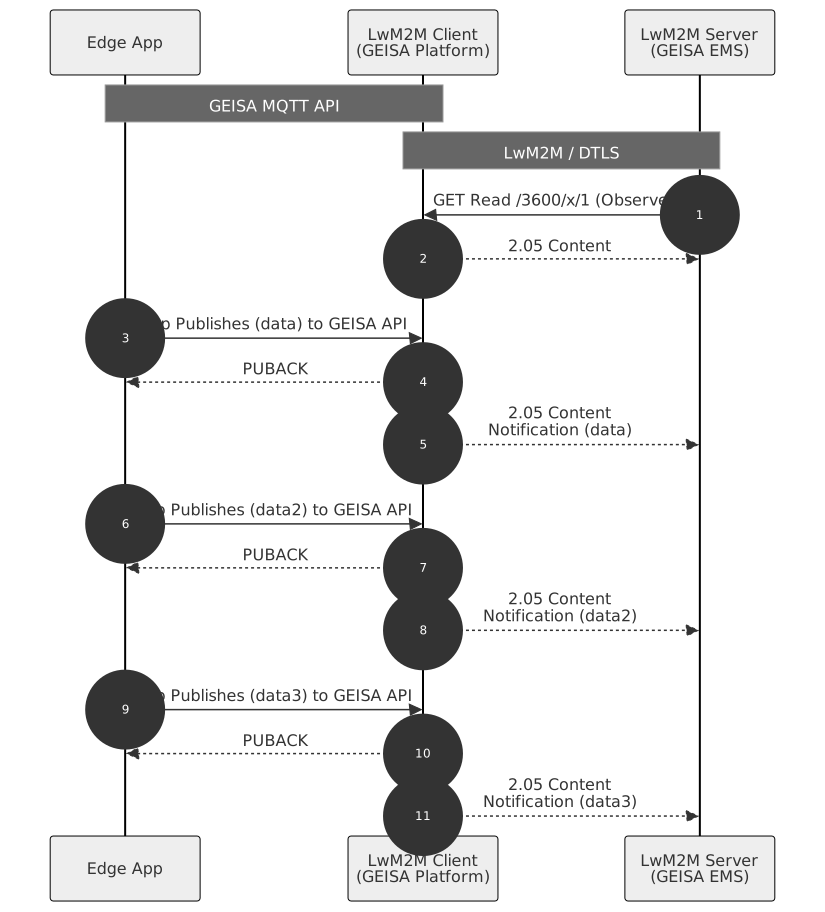
Figure 11.11 Edge App Message Reporting
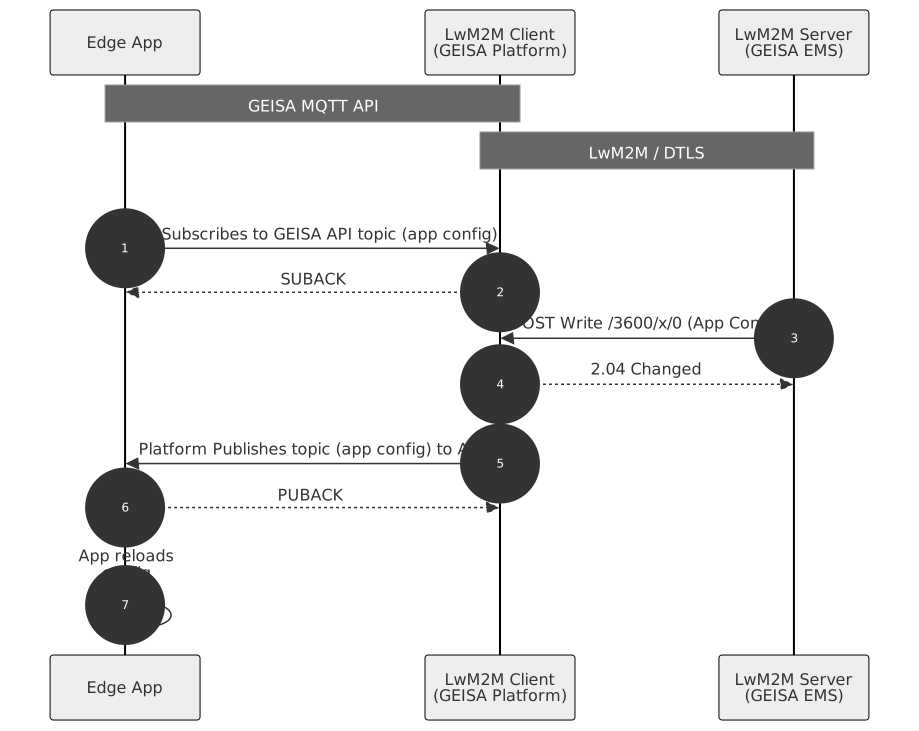
Figure 11.12 Edge App Message Delivery