7. Operations
This chapter provides a high-level operational view of how GEISA roles, systems, artifacts, and interoperability areas relate to each other end to end.
It is intended to help readers understand the overall system context before moving into the more detailed materials covered elsewhere such as System Architecture, Application & Device Management, Linux Execution Environment, Virtual Execution Environment, Application Programming Interface (API), and Security.
Note
This chapter is explanatory in nature. Detailed protocols, APIs, payloads, lifecycle, and security requirements are defined in the relevant chapters of this specification.
7.1. Purpose and Scope
GEISA is intended to support end-to-end interoperability across the lifecycle of utility edge platforms, edge applications, and other upstream systems. In practice, the overall system can be difficult to understand when viewed only through one protocol, one component, or one’s own specific organizational responsibilities.
This chapter reframes the system in terms of GEISA roles and major operational interactions. It is intended to clarify how the management plane, execution environments, application interfaces, trust decisions, and operational reporting concerns all fit together at a system level.
The operational view in this chapter complements the interoperability goals described in Introduction and the general architectural material in System Architecture.

7.2. Roles and Authorities
GEISA describes operational interactions in terms of roles rather than broad organization categories, as a single organization may perform one or more roles depending on the workflow being discussed and specific implementations.
For example, a device manufacturer may also provide managed services and, in a particular deployment, may act in the role of Platform Provider, EMS Provider, and/or System Operator. In GEISA, responsibilities and decision authority are tied to the role being performed in the relevant interaction, regardless of the type of organization with specific role responsibilities. However, there is one notable callout: the utility is expected to often be the one driving the underlying operational decisions, even in cases where another organization is performing the day-to-day operational duties on their behalf.
The principal roles used in this operational view are:
-
The role with the authority to set policies for a specific operating environment. Typically, this role has both ownership of the assets and liability for maloperation, though this may not always be the case. In most cases, the system owner is the utility.
-
The role responsible for approving, configuring, authorizing, deploying, and operating GEISA-managed devices and applications within a specific operating environment in accordance with agreed-on policies. The Operator effectively runs the day-to-day systems, although they may be beholden to another organization such as the Utility to dictate actual policies to be followed.
Often the System Operator will be the utility; however, they may choose to delegate portions of the system operator role to a third party.
-
The role responsible for supplying the platform hardware, platform software, and associated platform trust material where applicable. This may be a single provider or a hardware provider may be separate.
Application Publisher / Application Vendor
The role responsible for producing and signing an application artifact and supplying its vendor manifest and associated publisher trust material.
-
An optional (as of this version of the specification) role that may independently assess, test, or countersign application artifacts as validated and safe for deployment purposes. Depending on the applicable program or market, this assessment may emphasize either a “does no harm” model focused on behavioral and policy safety, a more detailed “does what is promised” model focused on functional or analytic claims, or both.
-
A workload running within a GEISA execution environment and using GEISA platform services and the GEISA Application Programming Interface (API). Typically, provided by an Application Publisher / Application Vendor.
-
A device running platform software that supports services conformant with the GEISA specification. Typically, System Operators deploy Edge Devices to be able to serve a core business purpose (e.g. metering, fault detection, etc.) while also supporting execution of Edge Applications. A GEISA Edge Device embodies a GEISA Platform Implementation, but is usually more (e.g. a meter, fault indicator, etc.)
ADM / Application and Device Management
ADM is the GEISA pillar for Application & Device Management. The ADM pillar defines the interfaces required for interactions between an Edge Management System and Edge Devices.
It spans the capabilities required for application ingestion, operator approval for deployment, deployment, activation, deactivation, updates, and broader lifecycle management of both the platform and the applications running on it. These capabilities may be realized by a single EMS that leverages LwM2M, or by multiple cooperating components, provided the required GEISA ADM behaviors and transactions are satisfied. On the edge device, this capability set includes the EMA and related edge-side management functions.
EMS / Edge Management System
The management system role responsible for exposing GEISA-conformant management behavior to the operator and communicating with conformant platforms as described in Application & Device Management.
EMA / Edge Management Agent
The platform-side management function that implements the required ADM support on a GEISA platform on edge devices.
The following terms are also important to this chapter:
ADM and API are GEISA interoperability areas and components covered in detail in Application & Device Management and Application Programming Interface (API).
LEE and VEE are GEISA execution environments covered in detail in Linux Execution Environment and Virtual Execution Environment.
Platform Implementation describes the realized combination of hardware and software that provides one or more GEISA-conformant interfaces.
When policy, approval, deployment scope, resource allocation, or trust authorization is in question, the System Owner has final authority for the target deployment environment.
7.3. End-to-End Operational Context
At a high level, the System Operator uses an EMS to manage conformant platforms, authorize application deployment, and obtain operational visibility into the deployed fleet.
Within the platform, EMA provides the management behavior needed for device onboarding, lifecycle control, and application deployment as described in Application & Device Management. The platform may provide one or both of the GEISA execution environments, LEE and VEE, as described in Linux Execution Environment and Virtual Execution Environment. Applications use the GEISA API to interact with platform capabilities and platform-provided data as described in Application Programming Interface (API).
The Application Publisher supplies the application artifact and vendor manifest. The System Operator determines whether that application is approved for use in the relevant environment, such as test, limited deployment, or production deployment. The EMS then carries out the authorized deployment and lifecycle actions on the target devices.
The Platform Provider supplies the platform implementation and associated device or platform trust material where applicable. The same provider may also supply additional services or systems, but those services are distinct from the role boundaries used within this specification.
This figure is intentionally high-level. It is provided to help readers understand how the principal GEISA roles, systems, and interoperability areas relate end to end.

Figure 7.1 End-to-End Operational Context Diagram
To understand how these roles and components interact, consider the process of deploying an application. Initially, a system operator may engage with an application certifier to verify the provenance (and potentially other attributes) of the application. This optional activity requires that the application publisher submit their application to the certifier, and that the system operator have a relationship with the certifier as well.
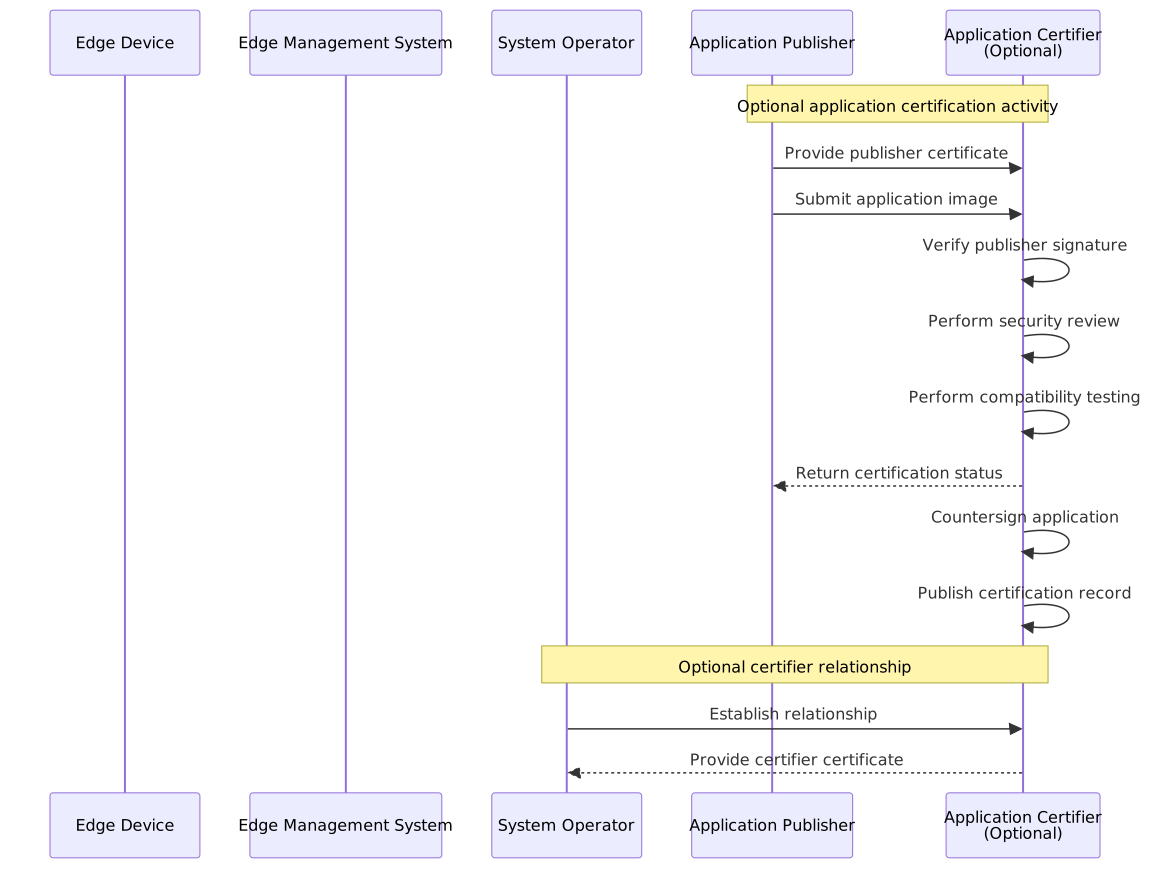
Figure 7.2 Optional Application Certification Sequence Diagram
Note that application certification is distinct from GEISA specification conformance testing, as described in Conformance.
The system operator chooses to acquire a new application. This process involves obtaining the application image and publisher certificate from the application publisher, and optionally obtaining the application certification record from the application certifier.
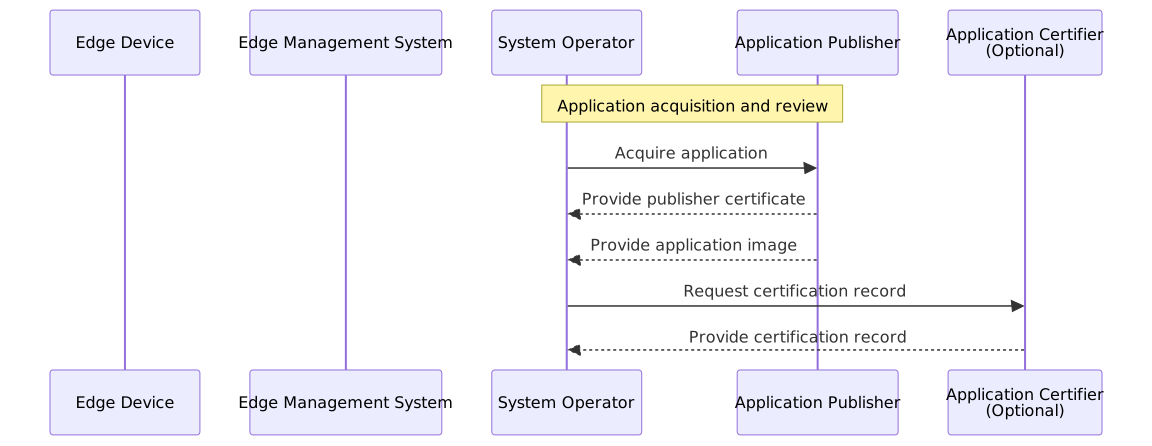
Figure 7.3 Application Acquisition Sequence Diagram
Having aquired the new application, the system operator verifies the application signatures and approves the application, creating and signing a deployment manifest for it.
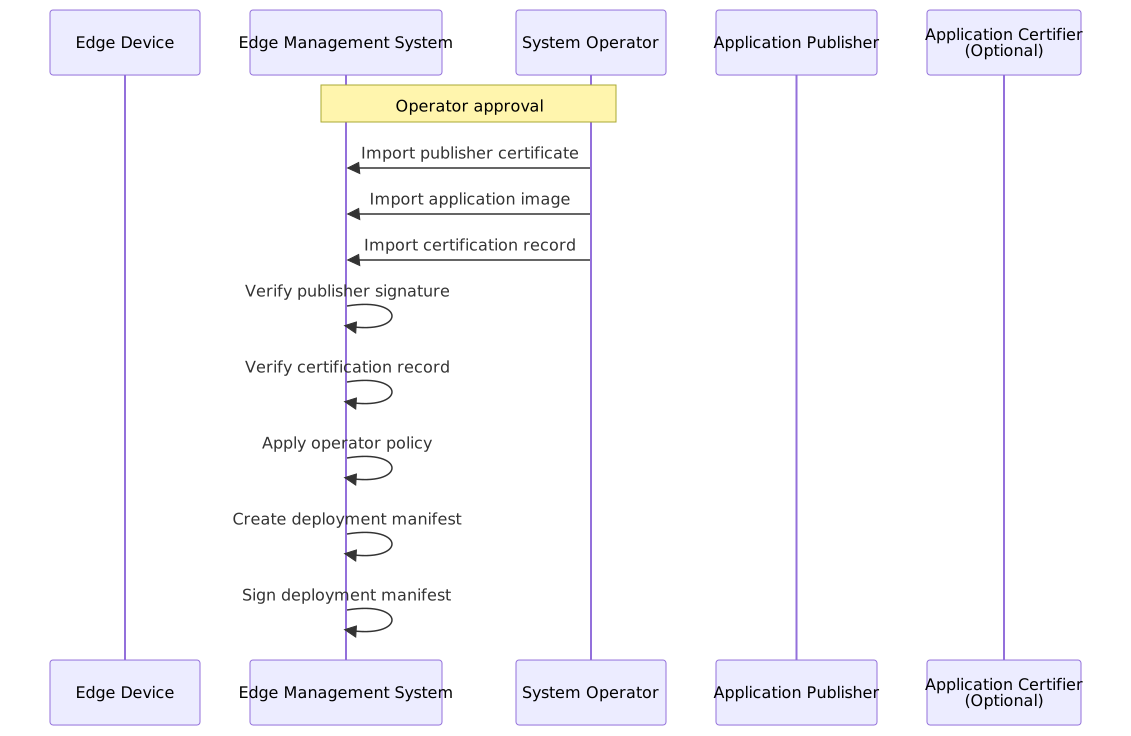
Figure 7.4 Application Approval Sequence Diagram
Once the application is approved, the System Operator can use the Edge Managment System to deploy it the Edge Devices.
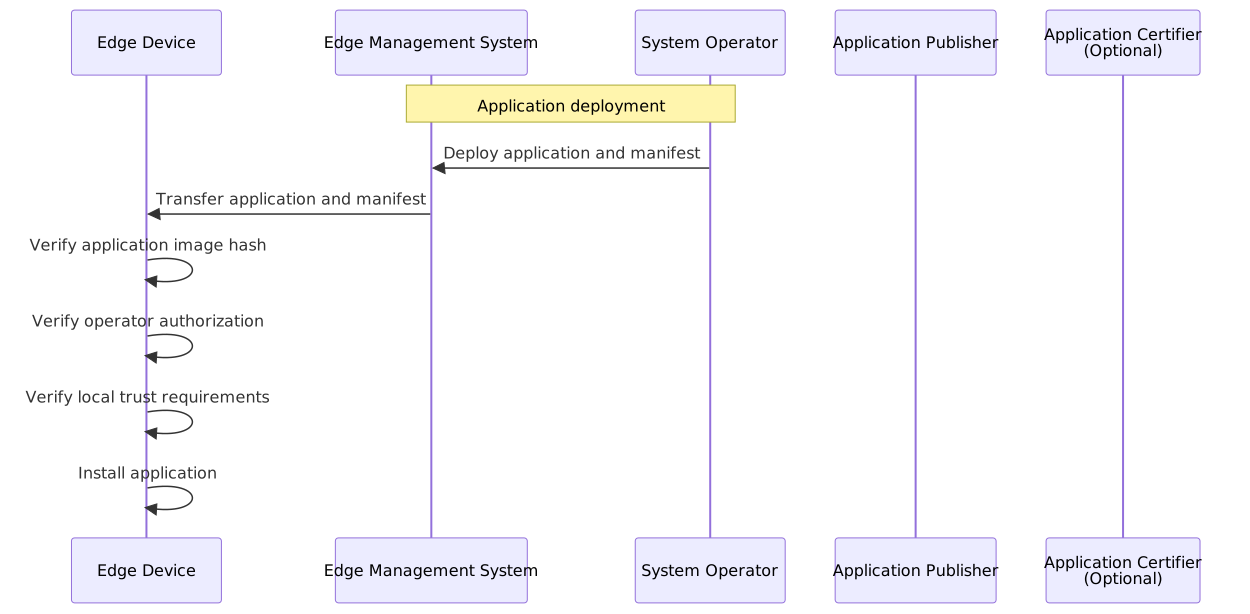
Figure 7.5 Application Deployment Sequence Diagram
Once deployed, the application can be activated, bringing it to a running state. The running application can then report its status, via the platform to the Edge Management System.
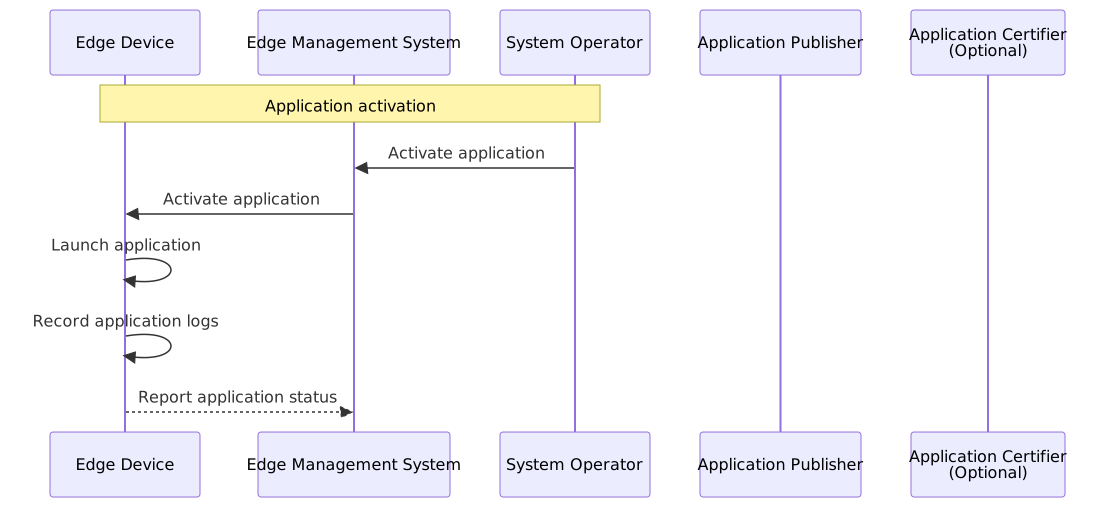
Figure 7.6 Application Activation Sequence Diagram
7.4. Operational Capability
This chapter is explanatory and does not add or alter specific requirements detailed elsewhere in this specification. In particular, Application & Device Management continues to define required interoperable ADM behaviors and transactions.
Operational capability includes management, lifecycle, deployment, visibility, reporting, and integration concerns across platform and operator workflows.
7.5. Device Onboarding and Management Overview
GEISA device onboarding establishes the management relationship between a conformant platform and a conformant EMS. In operational terms, this includes device provisioning, network attachment, bootstrap or initial trust establishment, registration, and subsequent lifecycle management.
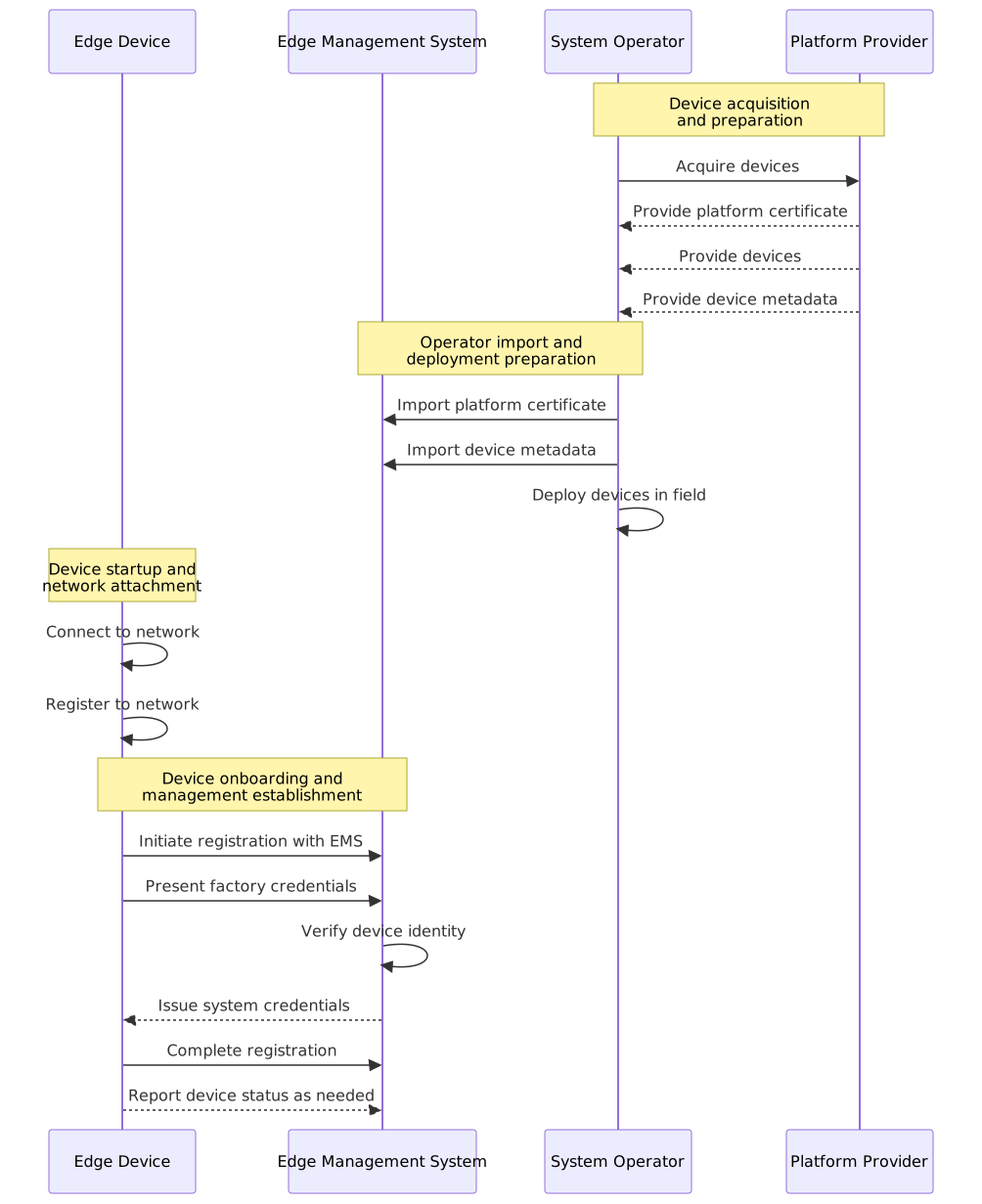
Figure 7.7 Device Onboarding Sequence Diagram
Additional detailed device onboarding workflows and requirements may be added in a future revision of the specification.
7.6. Application Approval and Deployment Overview
GEISA application deployment begins with application sourcing and review, continues through operator authorization and deployment preparation, and ends with transfer and installation on target devices.
This specification distinguishes between the vendor manifest supplied by the Application Publisher and the effective deployment manifest approved by the System Operator. Operationally, this means publisher-provided identity, compatibility, defaults, and requested resources are inputs to the deployment decision, but the final approved deployment parameters remain under operator control.
Warning
System operators are solely responsible for their configuration decisions. System operators control what deployment parameters are used when deploying applications. This work is done without notice to, verification by, or approval by application or platform vendors. Failing to follow publisher recommendations may result in adverse performance under some conditions.
Additional detailed application approval and deployment workflows and requirements may be added in a future revision of the specification.
7.7. Off-Device Communication Approval
Applications may request message-based communication, IP socket communication, or both. Operationally, these requests are inputs to the deployment decision and do not entitle an Application to unmanaged network access. The System Operator determines whether requested communication is approved for the target deployment environment.
Direct IP socket communication should be reviewed as a distinct operational and security decision. Operators may choose to deny direct IP communication by default, approve it only for selected applications or destination classes, restrict it to operator-controlled endpoints, or require the platform to mediate approved traffic through routing, NAT, firewalling, forwarding, transparent proxying, or shared upstream connections.
The approval review should consider endpoint ownership, protocol and port scope, certificate and trust behavior, expected data volume, retry behavior, outage behavior, inbound exposure, fleet network capacity, and operational visibility. Inbound IP socket communication generally presents higher operational and security risk than outbound-initiated communication and may be limited to local endpoint use cases or denied by operator policy. This version of the specification does not define interoperable support for application-hosted listeners reachable from upstream operator networks or for peer-to-peer application communication over the AMI network. Those use cases may be considered in a future version if driven by operator or application requirements.
Platform-originated reporting should provide timely operator visibility
into denied access attempts, quota limits reached, unexpected egress attempts,
proxy or forwarding failures, and other policy violations.
Current application accounting and policy state may be exposed through GEISA
App Accounting Object /3602; application runtime health through GEISA App
Monitoring Object /3604; and platform service, queue, API, and
communication-path health through GEISA Platform Monitoring Object /3605.
Durable event, audit, and diagnostic records belong in Event Log Object
/20. Refer to OMA Lightweight M2M for the detailed GEISA ADM object model.
7.8. Application Activation and Runtime Visibility
After installation, GEISA applications are activated under operator control and execute within the platform’s selected execution environment. During runtime, the platform and EMS provide visibility into application and platform state, including activation state, execution state, status, and other operationally relevant data.
Additional detailed application activation and state information requirements may be added in a future revision of the specification.
7.9. Operational Reporting and Visibility
GEISA deployments require operational visibility into both the managed platform and the applications running on it. For purposes of this operational discussion, it is useful to distinguish between four broad reporting classes:
Application alerts
Near-real-time when feasible. These are application-originated alerts or condition notifications for which delayed awareness may materially reduce operator usefulness.
Application data
Data generated by applications for their own systemic use and consumption. This data is not necessarily as time-critical as application alerts and may be pushed on a periodic schedule or pulled periodically in a manner agreed to by the utility, relevant platform provider, and application publisher.
Platform-originated behavioral events
Near-real-time when urgent, otherwise routine or batched as appropriate. These are platform-originated observations or actions relating to application or platform behavior, such as repeated restart failure, policy violations, throttling, disablement, denied access attempts, unexpected outbound messaging, signature or hash mismatch events, or severe and persistent threshold violations.
Routine operational reporting
Slower and/or batched as appropriate. This includes lower-urgency operational data intended primarily for visibility, trending, support, audits, planning, license or usage review, and similar operational purposes.
This model preserves an important distinction between what an application reports, what the platform reports about the application, and what the platform or operator may do as a result of that behavior and data. Application-originated condition notifications or data messages may flow through GEISA messaging and off-device communication paths, but those messages are distinct from the broader operational reporting model for the platform or managed device fleet.
Operational monitoring and reporting may be distributed across the GEISA Platform and one or more upstream ADM components, including the EMS, LwM2M servers, analytics services, or other cooperating systems. Some implementations may perform substantial collection and evaluation upstream, while others may rely more heavily on the EMA and other platform-local functions. Hybrid arrangements are also valid.
On constrained, metered, delayed, or shared field networks, local collection, aggregation, threshold evaluation, and condition detection can often reduce bandwidth use and improve timely awareness. Upstream systems may then provide fleet-level correlation, storage, visualization, and operator workflows. Regardless of placement, the ADM implementation as a whole is expected to provide operator visibility into relevant behavioral, health, accounting, policy, and reliability conditions. Applicable object definitions determine the current state, counters, reasons, timestamps, and durable records available through the interoperable ADM interface.
The GEISA ADM object model separates this current state by scope.
Object /3601 provides host and device monitoring information;
/3602 provides application accounting and policy summary state;
/3604 provides application runtime monitoring and health;
and /3605 provides a platform-scoped aggregate level of view of
component, service, queue, API, and operational-path health.
Object /3606 represents the currently effective platform behavior for
monitoring, reporting, logging, queueing, and app-message handling, with
/3607 being the requested platform configuration which may differ until
accepted and deployed.
Object /3608 is an optional object whose Object Instances collectively
represent the complete logical component set used by an implementation to
realize the relevant platform requirements covered by this Object. This
Object does not require every operating-system service, library, or helper
process to be represented. Platform implementers may map their own components
using the vendor-specific or operator-specific reservation ranges for Component
Type and Component Role when an exact match is not already provided.
Application-originated messages may flow through Object /3600 and the
corresponding GEISA application-facing API paths. Those paths can carry
application status, events, alarms, telemetry, configuration, and other
app-message payloads, but Object /3600 is not a general platform event
bus and does not provide durable event or log history. Refer to
Application Messaging and Configuration for the detailed Application Messaging and Configuration
behavior.
LwM2M Observe is useful for selected current-state resources, but it is not
by itself a complete operational monitoring system. An EMS, LwM2M server, or
other upstream ADM component may use selective Observe, periodic Read or
Read-Composite operations, operator-initiated drilldown, /20 retrieval,
or a combination of these patterns according to operator policy,
authorization, reporting urgency, and network constraints. GEISA does not
assume that every object or resource is continuously observed, and it does
not prescribe whether most monitoring analysis resides locally, upstream, or
is distributed across both.
Expected categories of operational reporting and visibility include:
Lifecycle
Install counts, versions, uninstall counts, start and stop counts, and stated or desired reasons for transitions. This information is mostly routine, though some lifecycle transitions may require urgent visibility.
Behavioral / Stability
Crashes, forced shutdowns, restarts, throttling events, crash logs, policy violations, signature or hash mismatches, denied access attempts, unexpected outbound messaging, and similar platform-originated behavioral events. This category includes both routine visibility and urgent events that may require operator intervention.
Resource Consumption
Resource usage by application instance or group, threshold crossings, average and peak CPU, time above threshold, average and peak memory, and similar bounded-behavior metrics. Resource reporting is generally routine, but threshold crossings may escalate in urgency based on severity or persistence.
Platform / API / Data Reliability
Platform or device errors, API failures, failed calls, data gaps, timeout rates, and related indications that the deployed application or platform capability is not performing as intended. These conditions may be urgent when they materially impair the intended operational purpose of an application or platform capability.
Connectivity and Environment
Connectivity uptime, time synchronization status or drift, failed sends, average latencies, DNS failures, storage wear warnings, and similar conditions affecting reliable operation. This category is especially important when applications are deployed for emergency, safety, or other time-sensitive operational visibility.
License Count / Usage
Install counts, usage counts, or similar license-related visibility as applicable to the deployment or application business model. This information is generally routine and suitable for slower or batched reporting.
The current ADM object model provides interoperable resources for exposing current state, application messaging, and durable records. Future revisions may add richer end-to-end reporting workflows, operator integration guidance, and event taxonomies while preserving the separation between current state, app-message exchange, and durable history.
7.10. Utility and Enterprise Interaction Points
GEISA exists within a broader utility operational environment. In practice, the operator-facing GEISA systems and workflows may interact with utility or enterprise systems responsible for fleet operations, metering operations, analytics, customer or service workflows, and other business processes.
Detailed utility and enterprise integration workflow material may be added in a future revision of this chapter.
7.11. Application Certification
Application certification is distinct from GEISA specification conformance testing. Refer to Conformance for the scope and interpretation of GEISA conformance testing.
This chapter distinguishes between two broad certification models that may be relevant to GEISA application ecosystems. The industry continues to evolve and this may be expanded in a future revision. Costs as well as capabilities of individual providers able to be located to perform this function as a Utility may desire may also come into play.
Regardless, there are two broad types of certification we will consider at this time.
Basic - ‘does no harm’ certification
This model focuses primarily on whether the application remains within approved behavioral, resource, security, and policy bounds for safe deployment. Examples may include validating that the application does not access interfaces or data it was not granted, does not exhibit unacceptable restart or memory-growth behavior, does not exceed approved policy or threshold limits, does not produce unexpected outbound messaging, and does not otherwise destabilize or negatively impact the platform or adjacent functions.
Evidence of interest to such a program may include denied access attempts, restart storms, persistent memory or resource threshold violations, throttling, shutdown or disablement actions, signature or hash mismatch events, and related Platform-originated behavioral events.
Depending on the implementation, its level of ADM conformance, supported platform capabilities, and applicable resources, this evidence may be represented across several ADM objects. Object
/3602may provide accounting, quota, and throttling evidence;/3604may provide application runtime, crash, restart, and platform-action evidence; and/3605may provide platform service, queue, API, communication-path, and policy-enforcement evidence. Object/20may retain durable event, audit, diagnostic, and historical records. The evidence available depends on the implementation’s ADM conformance scope, platform capabilities, supported resources, reporting policy, and retained history. See OMA Lightweight M2M for the detailed GEISA ADM object model.Deeper Functional Certification
This model focuses more directly on validating whether an application satisfies a deeper specific functional and/or performance claim, such as analytics accuracy, condition-detection fidelity, expected true or false positive rates, interoperability with specific external devices, or similar claims. It is essentially - ‘does this application do what is promised?’
This type of certification may be substantially more complex and expensive, particularly for applications that make use of local AI inferencing, hybrid edge/cloud processing, behind-the-meter integrations, or other advanced workflows.
This model may also require access to details, methods, or validation detail that some publishers may consider sensitive or proprietary.
Figure 7.8 Optional Application Certification Sequence Diagram
As of this version of the specification, GEISA does not define a singular or specific certification program or require either model; however, it is useful to distinguish these models explicitly because they address different operator, certifier, publisher, and ecosystem concerns. In the near term, GEISA or GEISA-conformant systems may more naturally support does-no-harm style certification than exhaustive functional-claim certification, although Platform Providers and Operators should consider if a given Platform provides enough capabilities to support both types of Certification.
7.12. Future Considerations
This chapter is intended to establish the operational frame for the GEISA system. Additional operational detail is expected to be added over time.
Examples of areas that may be expanded in a subsequent version of the specification include detailed application certification workflows, richer operator-side discovery or notification of newly available applications, enterprise integration patterns, meter-specific lifecycle workflows such as meter swap or move-in and move-out support, more detailed operational reporting and visibility models, and more explicit event taxonomies for application alerts and Platform-originated behavioral events.