4. Introduction
The Grid Edge Interoperability and Security Alliance (GEISA) Specification addresses interoperability for edge computing environments used by electric utilities. These edge environments are often found in Advanced Metering Infrastructure (AMI) meters, but may also be present in Distribution Automation (DA) devices, customer gateways, or other utility-owned devices.
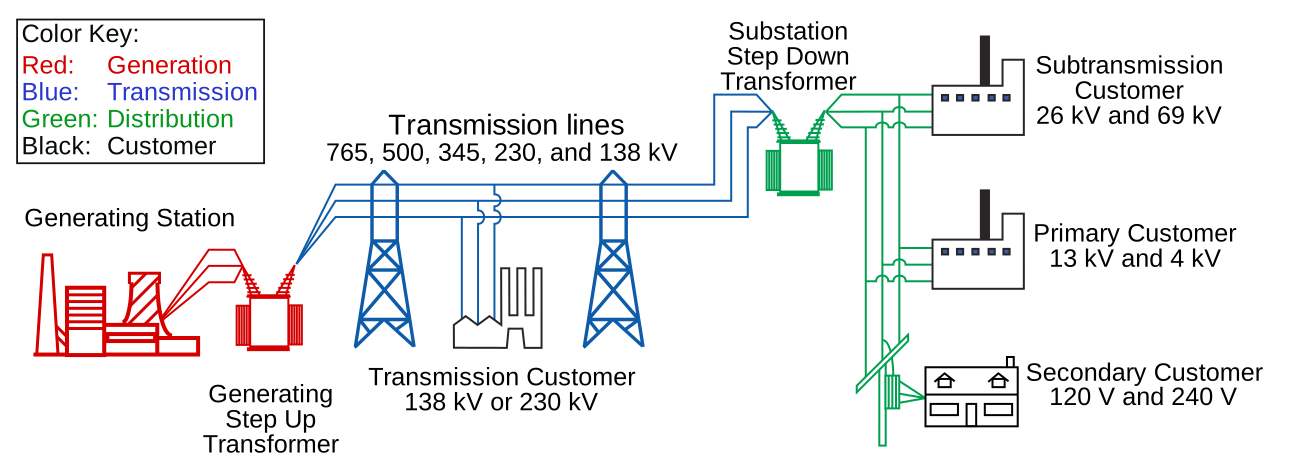
Figure 4.1, above, shows a simplified view of North American electricity grid. Electricity grids in other parts of the world are generally similar, though the voltage levels are often different. While the GEISA specification may be used to provide interoperable edge intelligence in any device, GEISA is primarily focused on device that live in the distribution network, shown in green in Figure 4.1. Edge intelligence for substations is likely better served by the LF Energy SEAPATH project, https://seapath.energy/.
Within the electricity distribution network, electric utilities or distribution network operators deploy a variety of different devices to manage their networks. Smart electricity meters are used to record customer energy consumption and serve as grid sensors, providing data on outages and other events. Load tap changers and capacitor bank controllers are used to ensure that voltage stays within accepted tolerances. Remote fault indicators help network operators determine the physical location of grid failures. Remote intelligent switches and remote automatic reclosers support automatic recovery from faults and allow reconfiguration of the distribution network without sending personnel into the field.
All of these devices could potentially benefit from the ability to deploy applications on them. GEISA allows utilities or distribution network operators to deploy interoperable edge applications from different vendors on to devices from different vendors and manage them all with a single management system. This capability enables a much more flexible, capable distribution grid. System operators can deploy apps where needed, enabling a variety of different use cases from simple applications that enable flexible, site-specific load-control (e.g. if load exceeds X, operate relay) to complex waveform analysis and AI modeling.
The goal of the GEISA specification is to address end-to-end interoperability for edge environments.
Within the GEISA specification, interoperability is be broken down into three areas:
Application and Device Mangement
Application Programming Interface
Execution Environment

Application and Device Management (ADM) interoperability allows utilities to use a single management system to manage ADM-conformant devices from multiple vendors using an ADM-conformant management system. ADM defines the behaviors and protocols necessary to register and manage edge devices and the applications which run on them.
When this documentation notes something that is ADM-related, there may be an
orchestrator’s baton icon  to highlight it.


Application Programming Interface (API) interoperability allows software developers to interact with grid edge device specific capabilities, such as meter readings, waveform data, sensors, and actuators in a consistent manner. GEISA uses a message-bus based API so that application developers are not constrained to a specific programming language.
When this specification notes something that is API related, there may be a
gear icon  to highlight it.

Execution Environment (EE) interoperability defines the specific target environment a GEISA platform supports for running applications. This version of the GEISA specification defines two specific execution environments: A Linux Execution Environment and a Virtual Execution Environment.
Ocassionaly there are requirements common to both. When this specification
discusses execution environments in general, there may be a globe icon
 to highlight it.
Linux Execution Environment (LEE) interoperability allows software developers to have a consistent embedded Linux environment for running programs. LEE-conformant devices provide an isolated per-application execution environment containing a standard set of base libraries, a consistent filesystem layout, and other details which ensure application developers do not have to manage variations across different platform implementations.
When this specification notes something that is LEE related, there may be a Tux
icon  to highlight it.
Virtual Execution Environment (VEE) interoperability allows software developers to have a consistent virtual execution environment for running programs. VEE-conformant devices provide the ability to run programs that rely on standard managed-code; that is, code executed under the supervision of a virtual machine that provides memory management, security, and isolation. The minimal supported languages for managed-code for GEISA VEE are C/C++ and Java, with their respective libraries.
When this specification notes something that is VEE related, there may be a
connected cloud icon  to highlight it.
Vendor implementations of the GEISA specification may not support interoperability in all areas. For example, some vendors may support either a Linux execution environment (LEE), or a virtual execution environment (VEE), while other vendors may choose to support both, with a VEE running on top of or along side of a LEE environment. There is nothing in the specification that precludes supporting only one type of Execution Environment (LEE or VEE) or supporting both.
For clarity, this specification uses icons for each aspect of interoperability so it is clear which requirements apply to a given type of conformance. The icons are:

The goal of this specification is that two vendors working from the specification alone are able to create an implementation such that a GEISA-conformant application can run on nearly any GEISA-conformant platform without modification. Similarly, a vendor providing a GEISA-conformant ADM / management system should be able to manage a GEISA conformant platform without modifications.
Throughout this specification there are blocks associated with each aspect of interoperability. In this introduction, the blocks explain, at a high level, the interoperability behaviors a given aspect supports.
This specification follows [RFC2119] conventions, such as “MUST”, “MAY”, and “SHOULD” to indicate what is expected from a conformant implementation.
Please note that conformance for each of GEISA defined aspects of
interoperability (ADM , API , LEE
& VEE ) is considered independently.