11.2. Bootstrapping

As discussed in the LwM2M core specification [LwM2M-Core] section 6.1, there are four ways to bootstrap a device so that it knows how to contact its LwM2M server for management:
Factory Bootstrap
Bootstrap from Smartcard
Client Initiated
Server Initiated
Using Factory Bootstrap, devices are provisioned during manufacturing with security credentials and Management Server (edge management system) information. Upon initial field installation, devices will automatically connect directly to their Management Server (Edge Management System/EMS) to perform registration.
Under a Client-Initiated Bootstrap, shown below in Figure 11.1, devices are provisioned during manufacturing with Bootstrap Server (BS) information. Upon field installation, devices initiate the connection to the Bootstrap Server for the provisioning of Security credentials (object 0) and Management Server information (and subsequent registration).
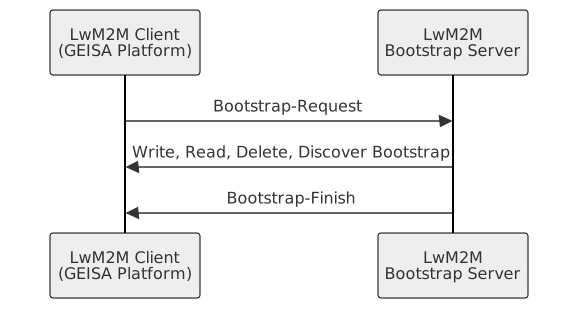
Figure 11.1 Client Bootstrap
As noted in [LwM2M-Core], GEISA ADM conformant devices SHALL support Client Initiated bootstrapping. GESIA ADM conformant devices MAY support other bootstrapping methods. For mass deployed devices, like smart meters, Factory Bootstrapping is usually preferred by system operators.
GEISA ADM conformant devices SHALL provide an accessible out-of-band mechanism which allows the system operator to preprovision the URL of the CoAp Bootstrap-Server, the Bootstrap-Server Account credentials, and any other data needed to complete the boostrapping process (e.g. certificates, keys, etc.).
Note
GEISA ADM Conformant EMS are not required to provide a Bootstrap Server. If a platform provider ships devices set to use client intiated bootstrap, it is expected that they will inform the purchaser in advance or provide a bootstrap server.
GEISA ADM conformant devices SHALL support EST-coaps per [RFC9148]. Certificate management is discussed in Security. The EST process requires that the GEISA devices know the address of the registration authority. For this version of the specification, the registration address may be provided either as part of a factory process or using an out-of-band mechanism. Build-to-order mass deployment devices are expected to be configured with the registration authority name in the factory. Build-to-stock and custom deployment devices are expected to be configured using a manufacturer tool prior to deployment.
Future versions of the specification may require DNS-SD, DHCP Options, and/or well known DNS names (e.g. geisa-ra). Mechanisms like Manufacturer-Signed CA Certificate Distribution for EST and EST-coaps Deployments [MITTAL] are also under consideration.